Why a Huge Pandemic Could Not Happen Again
Two Years Into the Pandemic, Americans Inch Closer to a New Normal
2 years after the coronavirus outbreak upended life in the United States, Americans discover themselves in an environment that is at one time greatly improved and frustratingly familiar.
Effectually 3-quarters of U.Southward. adults now study existence fully vaccinated, a critical safeguard against the worst outcomes of a virus that has claimed the lives of more than than 950,000 citizens. Teens and children as young as 5 are now eligible for vaccines. The national unemployment charge per unit has plummeted from nearly 15% in the tumultuous first weeks of the outbreak to around 4% today. A large majority of Thousand-12 parents report that their kids are back to receiving in-person pedagogy, and other hallmarks of public life, including sporting events and concerts, are again drawing crowds.
This Pew Enquiry Center data essay summarizes key public opinion trends and societal shifts as the United States approaches the second anniversary of the coronavirus outbreak. The essay is based on survey data from the Center, information from government agencies, news reports and other sources. Links to the original sources of data – including the field dates, sample sizes and methodologies of surveys conducted by the Center – are included wherever possible. All references to Republicans and Democrats in this analysis include independents who lean toward each party.
The mural in other ways remains unsettled. The staggering death price of the virus continues to rise, with nearly as many Americans lost in the pandemic'south 2nd year as in the first, despite the widespread availability of vaccines. The economic recovery has been uneven, with wage gains for many workers offset by the highest inflation charge per unit in four decades and the labor market roiled by the Great Resignation. The nation'south political fractures are reflected in about-daily disputes over mask and vaccine rules. And thorny new societal problems have emerged, including alarming increases in murder and fatal drug overdose rates that may exist linked to the upheaval caused past the pandemic.
For the public, the sense of optimism that the country might be turning the corner – evident in surveys shortly after President Joe Biden took office and as vaccines became widely available – has given way to weariness and frustration. A majority of Americans now give Biden negative marks for his handling of the outbreak, and ratings for other government leaders and public health officials have tumbled. Amid these criticisms, a growing share of Americans appear prepare to move on to a new normal, even equally the verbal contours of that new normal are hard to discern.
A year ago, optimism was in the air
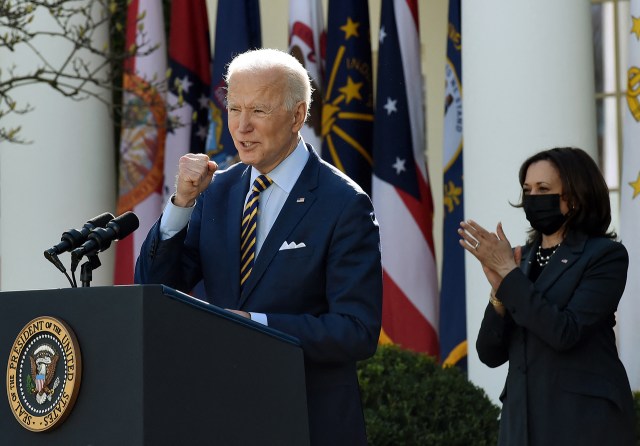
Biden won the White House in part because the public saw him every bit more qualified than sometime President Donald Trump to address the pandemic. In a January 2021 survey, a majority of registered voters said a major reason why Trump lost the election was that his administration did not exercise a good enough task handling the coronavirus outbreak.
At least initially, Biden inspired more conviction. In February 2021, 56% of Americans said they expected the new administration's plans and policies to better the coronavirus situation. By last March, 65% of U.S. adults said they were very or somewhat confident in Biden to handle the public health bear upon of the coronavirus.
The rapid deployment of vaccines only glassy Biden's standing. After the new president easily met his goal of distributing 100 million doses in his kickoff 100 days in office, 72% of Americans – including 55% of Republicans – said the administration was doing an excellent or good job overseeing the production and distribution of vaccines. As of this January, majorities in every major demographic group said they had received at to the lowest degree i dose of a vaccine. Most reported being fully vaccinated – defined at the time every bit having either ii Pfizer or Moderna vaccines or one Johnson & Johnson – and most fully vaccinated adults said they had received a booster shot, too.
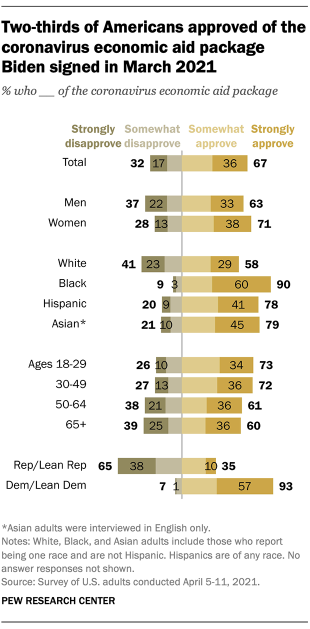
The Biden assistants's early moves on the economy too drew notable public back up. Ii-thirds of Americans, including around a 3rd of Republicans, approved of the $1.nine trillion assistance packet Biden signed into law final March, 1 of several sprawling economic interventions authorized past administrations of both parties in the outbreak's first year. Among the moving ridge of authorities spending, the U.S. economy grew in 2021 at its fastest annual rate since 1984.
Globally, people preferred Biden'south approach to the pandemic over Trump's. Beyond 12 countries surveyed in both 2020 and 2021, the median share of adults who said the U.S. was doing a skillful job responding to the outbreak more than doubled later on Biden took office. Even so, people in these countries gave the U.S. lower marks than they gave to Frg, the World Health Organisation and other countries and multilateral organizations.

A familiar undercurrent of partisan division
Even if the national mood seemed to be improving last bound, the partisan divides that became so apparent in the kickoff year of the pandemic did non subside. If anything, they intensified and moved into new arenas.
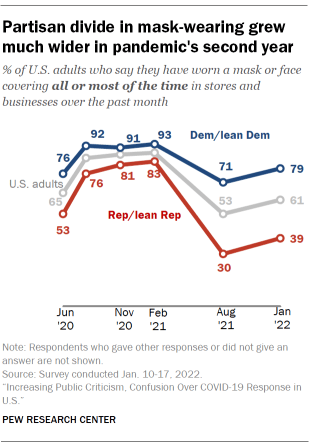
Masks and vaccines remained 2 of the about loftier-contour areas of contention. In February 2021, Republicans were only 10 percentage points less likely than Democrats (83% vs. 93%) to say they had worn a face up covering in stores or other businesses all or most of the time in the by month. By January of this year, Republicans were forty points less likely than Democrats to say they had done so (39% vs. 79%), fifty-fifty though new coronavirus cases were at an all-time high.
Republicans were also far less likely than Democrats to be fully vaccinated (sixty% vs. 85%) and to have received a booster shot (33% vs. 62%) as of Jan. Not surprisingly, they were much less likely than Democrats to favor vaccination requirements for a variety of activities, including traveling by aeroplane, attending a sporting result or concert, and eating inside of a eating house.
Some of the virtually visible disputes involved policies at Thou-12 schools, including the factors that administrators should consider when deciding whether to keep classrooms open for in-person instruction. In January, Republican Chiliad-12 parents were more likely than Democrats to say a lot of consideration should be given to the possibility that kids will fall behind academically without in-person classes and the possibility that students will have negative emotional consequences if they don't attend school in person. Democratic parents were far more than probable than Republicans to say a lot of consideration should be given to the risks that COVID-19 poses to students and teachers.
The mutual thread running through these disagreements is that Republicans remain fundamentally less concerned almost the virus than Democrats, despite some notable differences in attitudes and behaviors within each party. In January, nearly two-thirds of Republicans (64%) said the coronavirus outbreak has been made a bigger bargain than it really is. Almost Democrats said the outbreak has either been approached about correct (l%) or made a smaller deal than it really is (33%). (All references to Republicans and Democrats include independents who lean toward each party.)
New variants and new problems
The reject in new coronavirus cases, hospitalizations and deaths that took place terminal bound and summer was so encouraging that Biden appear in a July 4 speech that the nation was "closer than ever to declaring our independence from a deadly virus." But the arrival of 2 new variants – first delta so omicron – proved Biden'south assessment premature.
Some 350,000 Americans have died from COVID-19 since July iv, including an average of more than 2,500 a solar day at some points during the contempo omicron moving ridge – a number not seen since the kickoff pandemic wintertime, when vaccines were not widely available. The huge number of deaths has ensured that fifty-fifty more Americans accept a personal connectedness to the tragedy.
The threat of dangerous new variants had always loomed, of course. In February 2021, around one-half of Americans (51%) said they expected that new variants would lead to a major setback in efforts to contain the affliction. Simply the ferocity of the delta and omicron surges still seemed to take the public ashamed, particularly when governments began to reimpose restrictions on daily life.
After announcing in May 2021 that vaccinated people no longer needed to clothing masks in public, the Centers for Disease Control and Prevention reversed course during the delta wave and over again recommended indoor mask-wearing for those in high-transmission areas. Local governments brought dorsum their own mask mandates. After, during the omicron moving ridge, some major cities imposed new proof-of-vaccination requirements, while the CDC shortened its recommended isolation menstruum for those who tested positive for the virus but had no symptoms. This latter motility was at least partly aimed at addressing widespread worker shortages, including at airlines struggling during the height of the holiday travel flavor.
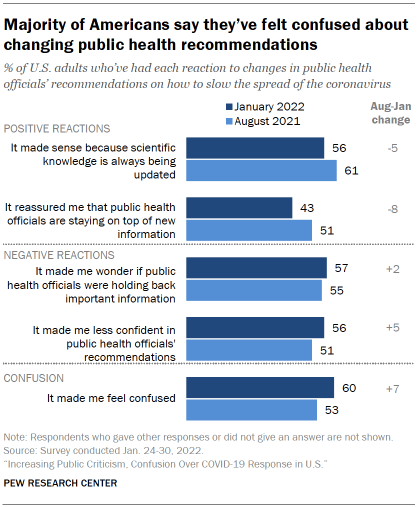
Amidst these changes, public frustration was mounting. Six-in-ten adults said in Jan 2022 that the changing guidance near how to slow the spread of the virus had made them feel confused, up from 53% the previous August. More than than half said the shifting guidance had fabricated them wonder if public health officials were withholding important information (57%) and made them less confident in these officials' recommendations (56%). And merely half of Americans said public health officials like those at the CDC were doing an excellent or good job responding to the outbreak, down from 60% last Baronial and 79% in the early stages of the pandemic.
Economic concerns, particularly over rising consumer prices, were also conspicuously on the ascension. Around ix-in-ten adults (89%) said in January that prices for food and consumer goods were worse than a year earlier. Effectually viii-in-ten said the same thing about gasoline prices (82%) and the price of housing (79%). These assessments were shared across party lines and backed upwards by government data showing large cost increases for many consumer appurtenances and services.
Overall, only 28% of adults described national economic weather condition every bit excellent or skillful in January, and a similarly minor share (27%) said they expected economic weather condition to be better in a year. Strengthening the economy outranked all other issues when Americans were asked what they wanted Biden and Congress to focus on in the year ahead.
Looking at the bigger picture, near eight-in-10 Americans (78%) said in January that they were not satisfied with the mode things were going in the state.
Imagining the new normal
As the third twelvemonth of the U.S. coronavirus outbreak approaches, Americans increasingly appear willing to accept pandemic life as the new reality.
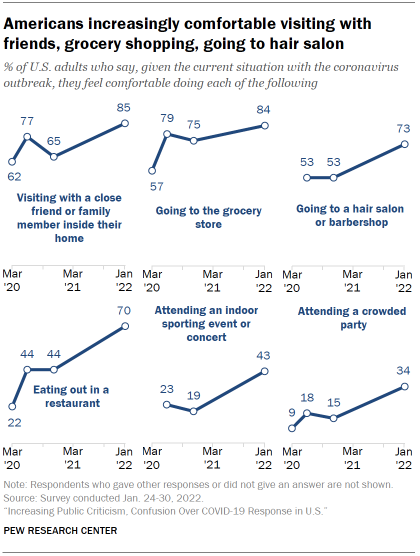
Large majorities of adults now say they are comfortable doing a multifariousness of everyday activities, including visiting friends and family inside their domicile (85%), going to the grocery store (84%), going to a hair salon or barbershop (73%) and eating out in a eating house (lxx%). Among those who accept been working from habitation, a growing share say they would be comfortable returning to their office if it were to reopen soon.
With the delta and omicron variants fresh in heed, the public also seems to have the possibility that regular booster shots may be necessary. In Jan, nearly ii-thirds of adults who had received at to the lowest degree one vaccine dose (64%) said they would exist willing to become a booster shot about every 6 months. The CDC has since published research showing that the effectiveness of boosters began to wane after 4 months during the omicron moving ridge.
Despite these and other steps toward normalcy, dubiety abounds in many other aspects of public life.
The pandemic has changed the mode millions of Americans do their jobs, raising questions about the future of work. In Jan, 59% of employed Americans whose job duties could be performed remotely reported that they were all the same working from dwelling house all or about of the time. Only unlike earlier in the pandemic, the majority of these workers said they were doing so by choice, not because their workplace was airtight or unavailable.
A long-term shift toward remote work could have far-reaching societal implications, some good, some bad. Most of those who transitioned to remote work during the pandemic said in January that the change had made information technology easier for them to balance their work and personal lives, but most too said it had made them feel less continued to their co-workers.
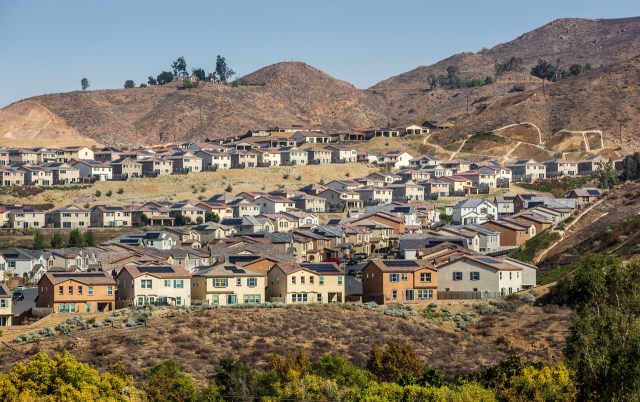
The shift away from office spaces as well could spell trouble for U.S. downtowns and the economies they sustain. An October 2021 survey plant a decline in the share of Americans who said they preferred to live in a city and an increase in the share who preferred to live in a suburb. Earlier in 2021, a growing share of Americans said they preferred to live in a customs where the houses are larger and further apart, even if stores, schools and restaurants are farther away.
When information technology comes to keeping K-12 schools open, parental concerns about students' academic progress and their emotional well-beingness now clearly outweigh concerns most kids and teachers beingness exposed to COVID-19. But disputes over schoolhouse mask and vaccine rules take expanded into broader debates nigh public pedagogy, including the function parents should play in their children'due south instruction. The Keen Resignation has non spared G-12 schools, leaving many districts with shortages of teachers, bus drivers and other employees.
The turmoil in the labor market as well could exacerbate long-standing inequities in American social club. Among people with lower levels of education, women have left the labor forcefulness in greater numbers than men. Personal experiences at work and at domicile take also varied widely by race, ethnicity and household income level.
Looming over all of this uncertainty is the possibility that new variants of the coronavirus will sally and undermine any commonage sense of progress. Should that occur, will offices, schools and mean solar day care providers again close their doors, complicating life for working parents? Volition mask and vaccine mandates snap back into strength? Will travel restrictions return? Volition the economical recovery be interrupted? Volition the pandemic remain a leading mistake line in U.S. politics, particularly as the nation approaches a key midterm election?
The public, for its part, appears to recognize that a swift render to life every bit information technology was before the pandemic is unlikely. Even before the omicron variant tore through the state, a majority of Americans expected that it would be at least a year earlier their own lives would return to their pre-pandemic normal. That included i-in-v who predicted that their own lives would never go dorsum to the way they were before COVID-xix.
Lead photo: Luis Alvarez/Getty Images.
Source: https://www.pewresearch.org/2022/03/03/two-years-into-the-pandemic-americans-inch-closer-to-a-new-normal/

Post a Comment for "Why a Huge Pandemic Could Not Happen Again"